Ephemeral → Transcendental.
Mark Nara
June 20, 2025
An interview with Mark Nara, by Alexander Illiad
This post is part of an ongoing Q&A series. Thirty questions in total exploring themes of initiation, identity, meaning, and transformation.
Each one stands alone, but together they map a deeper conversation I’ve been guiding for years through Tattoo Pathway.
Rather than polished essays or formal teachings, these responses reflect the way things actually unfold in dialogue.
The first question started with a dream. You can go back to it here if you want to see where this began.

Question 7 (AI):
You often say that tattooing is a form of record keeping. What do you mean by that and why does it matter what’s being recorded?
Answer (MN):
Record-keeping is one of the innate, inescapable functions of tattooing. It happens whether you’re aware of it or not.I first received that understanding in a sweat lodge, during one of our early ceremonies. We were sitting in the dark and Wind said something that pierced straight through me.
He looked at me and said, You’re a record-keeper.
He wasn’t giving me a title. He wasn’t placing me above anyone else. He was naming something archetypal. Something ancient. Something tattooing has always been. That moment felt like someone dropped a zip-file straight into my chest. As it started to open, I realised I didn’t yet have the computing power to fully unpack it.
That was over a decade ago. And it’s taken every year since to begin understanding what that meant.
Tattooing, at its core, is a technology of remembrance. A ritual of recording. It marks a moment in time and carries it forward, long after the moment has passed. It’s takes the ephemeral and turns it into the transcendental.
When someone gets a tattoo, it records at multiple levels.
It records a story about who they were, where they were, and what they believed at that time.
It records physically, through the breaking of the skin, the trauma, the scar. The body remembers.
It records symbolically, through shape, placement, and meaning, both conscious and unconscious.
And it records energetically. Psychologically. Spiritually.
That’s why I say this is happening whether you know it or not. Whether you believe it or not. Whether you remember it or not. Your tattoos are bearing witness. And that has consequences.
Most people don’t realise this. They forget what their tattoos are. Sometimes they forget they even have them. But those tattoos haven’t forgotten them. They’re still there. Anchored. Influencing. Shaping.
I’ve seen people go through every spiritual and self-development practice imaginable. Plant medicine, therapy, retreats, shadow work, affirmations, dark retreats, meditations. . . but they’re still stuck. Still looping. Still tethered to a version of themselves they’re trying to evolve beyond.
And often, right there on their skin, is the anchor. A contract. Signed in blood. An unconscious agreement with the universe that said, This is who I am. This is what matters.
But they’ve moved on. They’re not that person anymore. The record remains.
So one of the most powerful things we can do is return to the record. Revisit it. Reassess it. Reclaim it.
In traditional cultures, record-keeping wasn’t abstract. The person overseeing a rite of passage (usually an elder) would ensure that the change was marked. Not just internally, but visibly. Symbolically. The community would see it. The world would see it. The divine would see it.
The mark meant something had changed. That a contract had been made. That accountability had been inherited.
That’s why I work with people to map their records. To excavate what they’ve inscribed, consciously or not. To be radically honest. To read the minutes of their own life.
Because these records bear weight. And if you don’t examine what they’re tethering you to, they might hold you back instead of pulling you forward.
And here’s the deeper layer. The zoom-out.
What if the record you carry through life, the story etched on your skin, isn’t just influencing your path here, but also your movement through death?
What if it’s a guide for the next world?
That’s a big claim, I know. But I’m working on unpacking that idea further. I’m exploring it in depth for the upcoming Afterlife Convention¹ in Sydney. The idea is that tattoos don’t just mark the body. They imprint the soul. They become part of the energetic architecture you carry beyond this life.
And across every culture, you’ll find stories of the afterlife that reference accountability, judgment, remembrance, the weighing of the soul. Even if they don’t mention tattooing directly, the principle remains: you are bringing something with you.
So, what are you recording?
What version of yourself are you anchoring in place?
Because the record will remain.
The question wont be what does the record say? more simpley are you aware and accountable?
¹ The Afterlife Convention.
Join Us at Awakin
The Hordern Pavilion, Sydney
28–29 June 2025
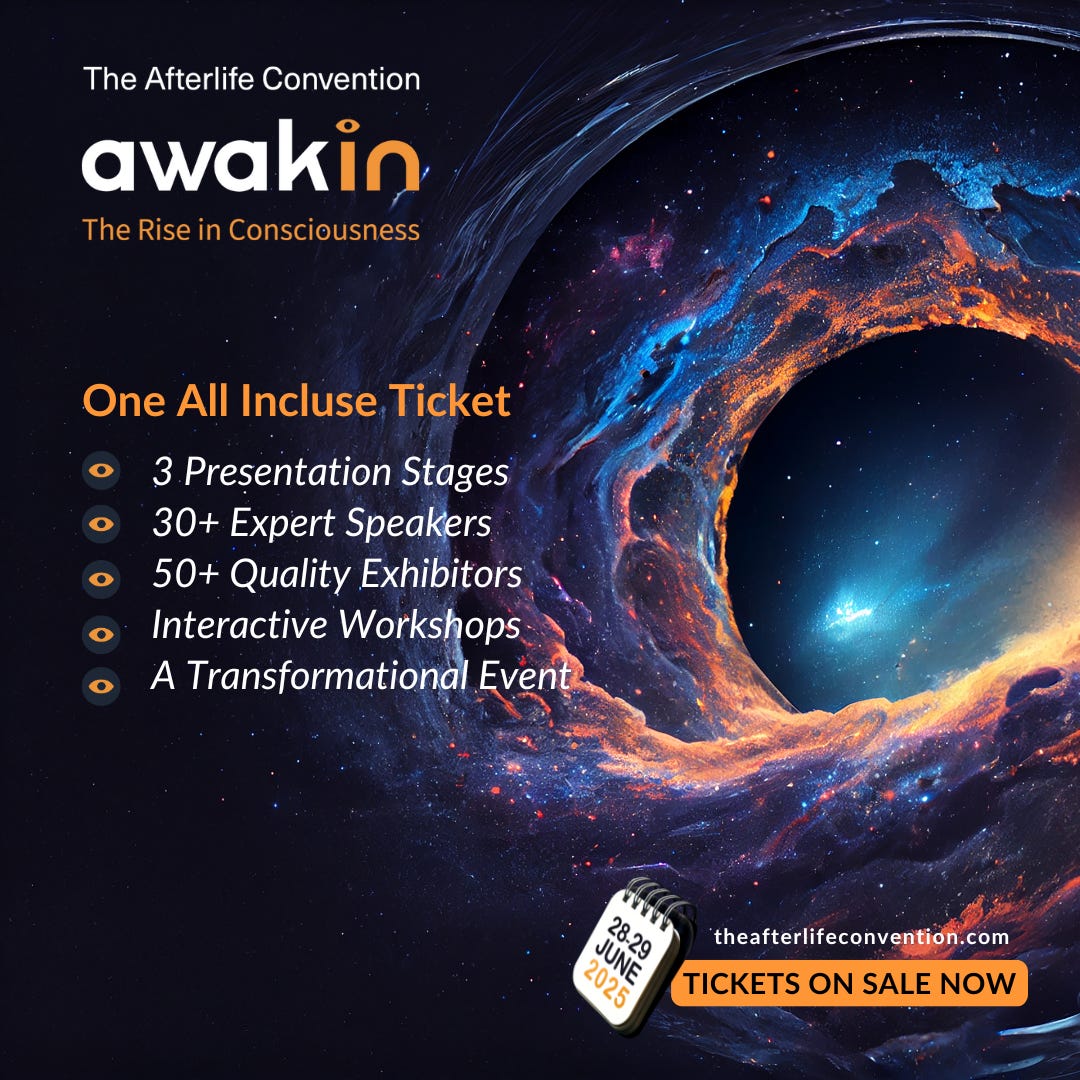
The Afterlife Convention is more than an event. It's an invitation into learning, healing, and conscious exploration.
Whether you're deep on your path or just starting to ask life's bigger questions, Awakin offers a welcoming space to explore what lies beneath the surface. You'll find opportunities for personal healing, transformation, mediumship, spiritual insight, and expanded states of awareness. No previous experience is required, and there are no religious overtones.
Take a moment to browse the speaker lineup, workshop schedule, and diverse range of exhibitors. You might find exactly what you've been searching for.
This is a chance to experience a new perspective on life and death. One that encourages growth, supports healing, and opens the door to possibility.
See you there,
MN.
Want updates when a new post is published?
Subscribe